
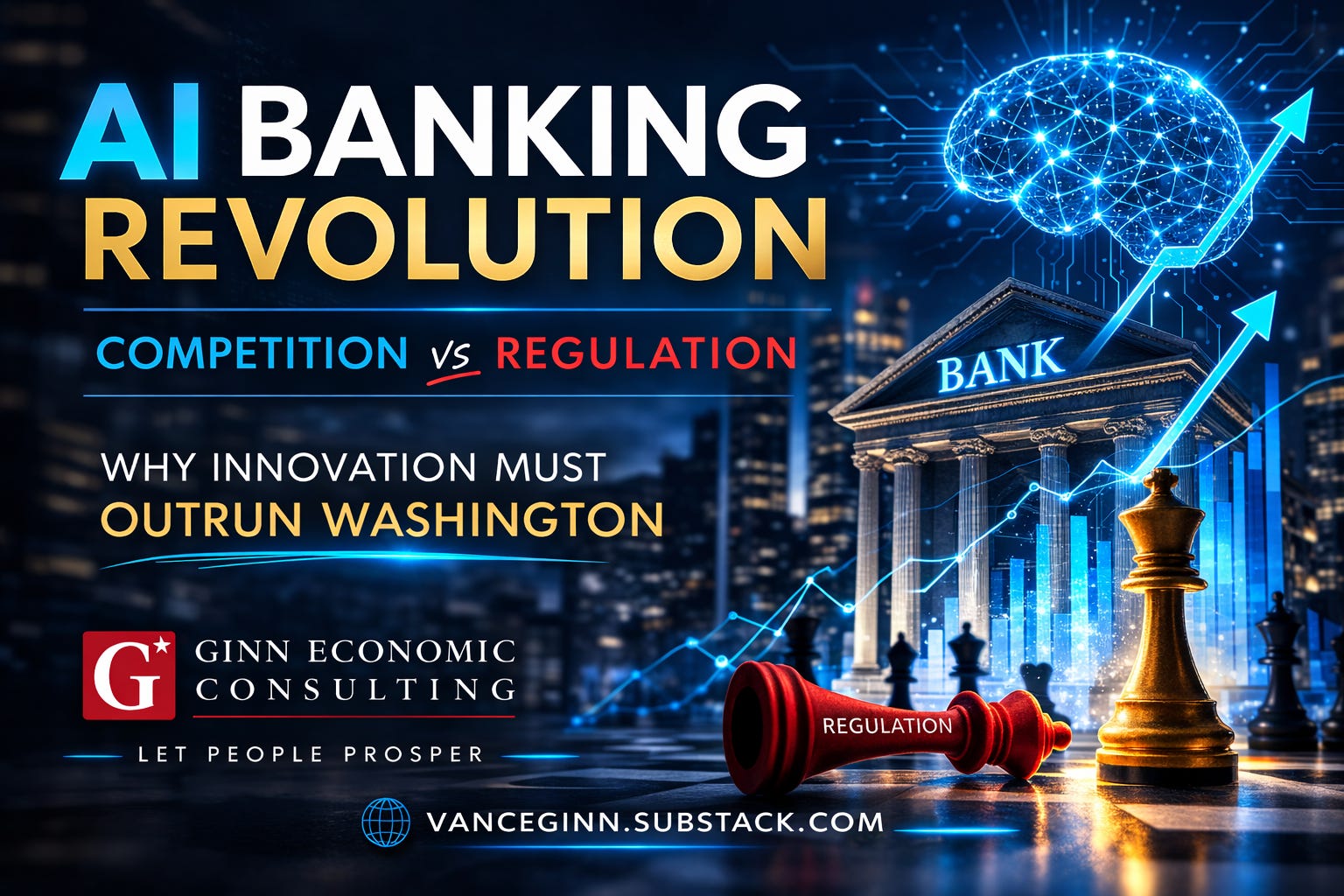
AI Banking Revolution Needs Freedom
Competition—not regulation—will shape financial innovation

Hello friends,
Artificial intelligence could revive competition in American banking. But not if Washington regulates it out of existence first.
Banks across the United States are pouring billions into artificial intelligence to detect fraud, analyze credit risk, automate compliance, and modernize their operations. As CNBC reports on Wall Street’s accelerating AI investment, financial institutions increasingly see AI as the next transformative technology for the industry.
This shift could expand competition across the financial system more than any regulatory reform Washington has attempted in decades.
But if policymakers follow their usual instinct—to regulate innovation before understanding it—they could slow the very revolution that might improve banking competition and financial access.
That would be a costly mistake.
The Next Financial Revolution
Artificial intelligence is not simply another financial software upgrade. It is the next major technological revolution in financial services.
AI systems can process enormous volumes of financial data in real time, allowing banks to detect fraud, evaluate lending risks, and automate regulatory compliance tasks that previously required massive administrative departments.
Financial institutions are already embedding these tools across their operations.
The Wall Street Journal reports that large banks are integrating AI deeply into core financial services as they modernize risk management and customer-facing technology.
The implications for financial competition are enormous.
Technology lowers barriers to entry. It reduces operational costs. And it allows smaller institutions and fintech firms to compete against established incumbents. That is how innovation expands opportunity.
AI Could Strengthen Community Banking
Artificial intelligence may be particularly important for smaller financial institutions.
Community banks and regional banks have faced rising regulatory costs for years. Compliance requirements have expanded while regulatory complexity has continued to grow.
Large financial institutions can spread those costs across enormous balance sheets. Smaller institutions cannot. Artificial intelligence offers a way to change that equation.
Automation can reduce administrative burdens. Machine learning can improve credit underwriting and fraud detection without requiring thousands of compliance personnel. Technology can lower barriers that previously limited competition.
If allowed to develop freely, AI could strengthen competition across the financial system. Consumers benefit when that happens.
The Real Risk Is Regulatory Overreach
Artificial intelligence itself is not the greatest threat to financial markets. Regulatory overreaction is.
Financial services are already one of the most heavily regulated sectors in the American economy. Adding sweeping new AI-specific regulatory frameworks could unintentionally entrench the largest incumbents. This pattern has played out repeatedly.
Rules intended to protect consumers often end up protecting the largest institutions that can afford the compliance burden. Startups and smaller banks often cannot.
Heavy-handed regulation risks slowing innovation and limiting competition precisely when technology could expand both.
America Must Lead the AI Race
Artificial intelligence in banking is part of a broader technological competition. The United States currently leads much of the global financial technology sector, but leadership is not guaranteed.
As The Washington Post reports on the growing global race over AI regulation and development, governments across the world are debating how aggressively to regulate emerging technologies.
Europe is leaning toward centralized regulatory frameworks. China is pursuing a state-directed model of technological development.
America’s advantage historically has been different. Entrepreneurship. Competition. Freedom to innovate.
In my research on Winning the Global Technological Race, I explain why maintaining that environment of innovation is essential if the United States wants to lead the next technological revolution.
Artificial intelligence will test whether policymakers still understand that lesson.
Financial Reform Still Matters
Artificial intelligence alone will not solve deeper structural problems in the financial system.
Over decades, regulatory accumulation and monetary policy distortions have reshaped financial markets in ways that often reduce competition rather than expand it.
In Correcting America’s Financial Future: Monetary Policy and Financial Regulation Guide, I outline how excessive regulation and distorted financial policy have weakened competition in American banking.
Artificial intelligence offers an opportunity to restore some of that competition. But only if policymakers allow markets to work.
Give Nothing a Chance
Whenever a new technology emerges, the political instinct is predictable. Government must act. New rules must be written. New regulatory frameworks must be built.
But often the best policy response is simpler: Give nothing a chance.
Markets coordinate information better than bureaucracies. Entrepreneurs adapt faster than regulators. Competition produces better outcomes than centralized mandates.
Every major economic transformation—from railroads to electricity to the internet—succeeded because innovation was allowed to develop before regulators tried to control it.
Artificial intelligence is simply the next chapter.
The Bottom Line
Artificial intelligence could dramatically expand financial competition, lower costs, and improve access to banking services.
But those gains will only materialize if policymakers resist the temptation to regulate innovation before it fully develops.
America has led every major technological revolution of the past century because entrepreneurs had the freedom to experiment and compete.
The AI banking revolution will test whether that tradition still holds.
Five Takeaways for Policymakers
Avoid premature regulation.
Artificial intelligence in finance is still evolving. Overregulation now risks freezing innovation before its benefits are fully realized.Encourage competition, not consolidation. Heavy regulatory frameworks often strengthen the largest institutions while limiting smaller competitors.
Modernize financial regulation. Decades of regulatory accumulation have already increased barriers to entry. Policymakers should focus on simplifying rules rather than layering new mandates.
Maintain America’s technological advantage. Innovation thrives in competitive markets. Overregulation risks pushing technological leadership elsewhere.
Let markets work. The best way to encourage financial innovation is often to remove barriers rather than create new ones.
Call to Action
If you are a policymaker, regulator, journalist, or financial industry leader, the choices made today about artificial intelligence will shape the future of financial competition.
Encourage innovation—or regulate the next financial revolution before it begins.
For deeper analysis, explore my research on Winning the Global Technological Race and financial reform in Correcting America’s Financial Future.
If this added value to you, share it with someone who should read it—and subscribe for weekly insights.
Let people prosper,
Vance Ginn, Ph.D.