

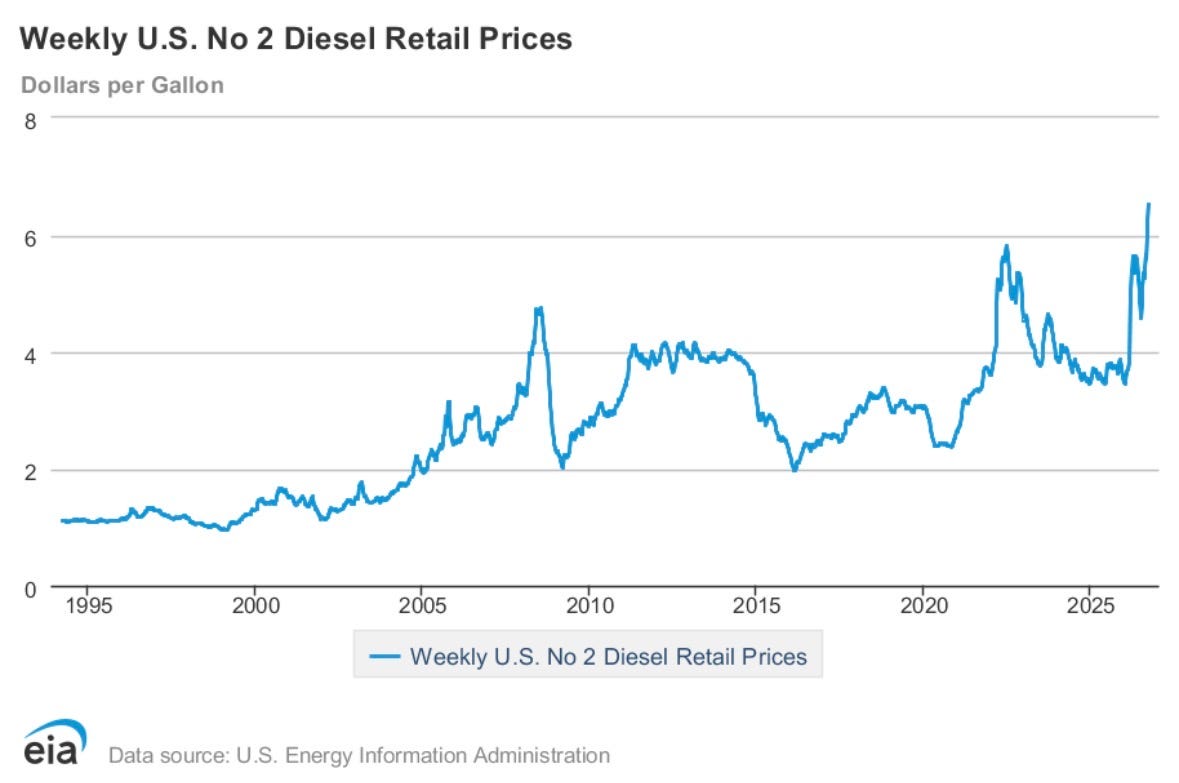
Diesel above $6 per gallon hurts. It hits truckers and farmers first, then works its way through freight, groceries, construction, manufacturing, and ultimately household budgets. So I understand the instinct to ask why American refiners are exporting diesel when prices are so high here.
But I’ve studied oil, gasoline, and diesel markets for nearly two decades, and there’s an important lesson in that research: prices reflect information about scarcity throughout the supply chain. Trying to suppress that signal doesn’t eliminate the scarcity.
That’s why President Trump’s consideration of a diesel export ban concerns me. The desire for lower prices is understandable. But the better response is to attack the causes of expensive energy rather than restrict where American refiners can sell it.
What’s In the Diesel Price?
The Energy Information Administration’s breakdown of what Americans pay at the pump is revealing. In May, when diesel averaged $5.60 per gallon, 42% of the price came from crude oil, 25% from refining, 23% from distribution and marketing, and 11% from taxes.
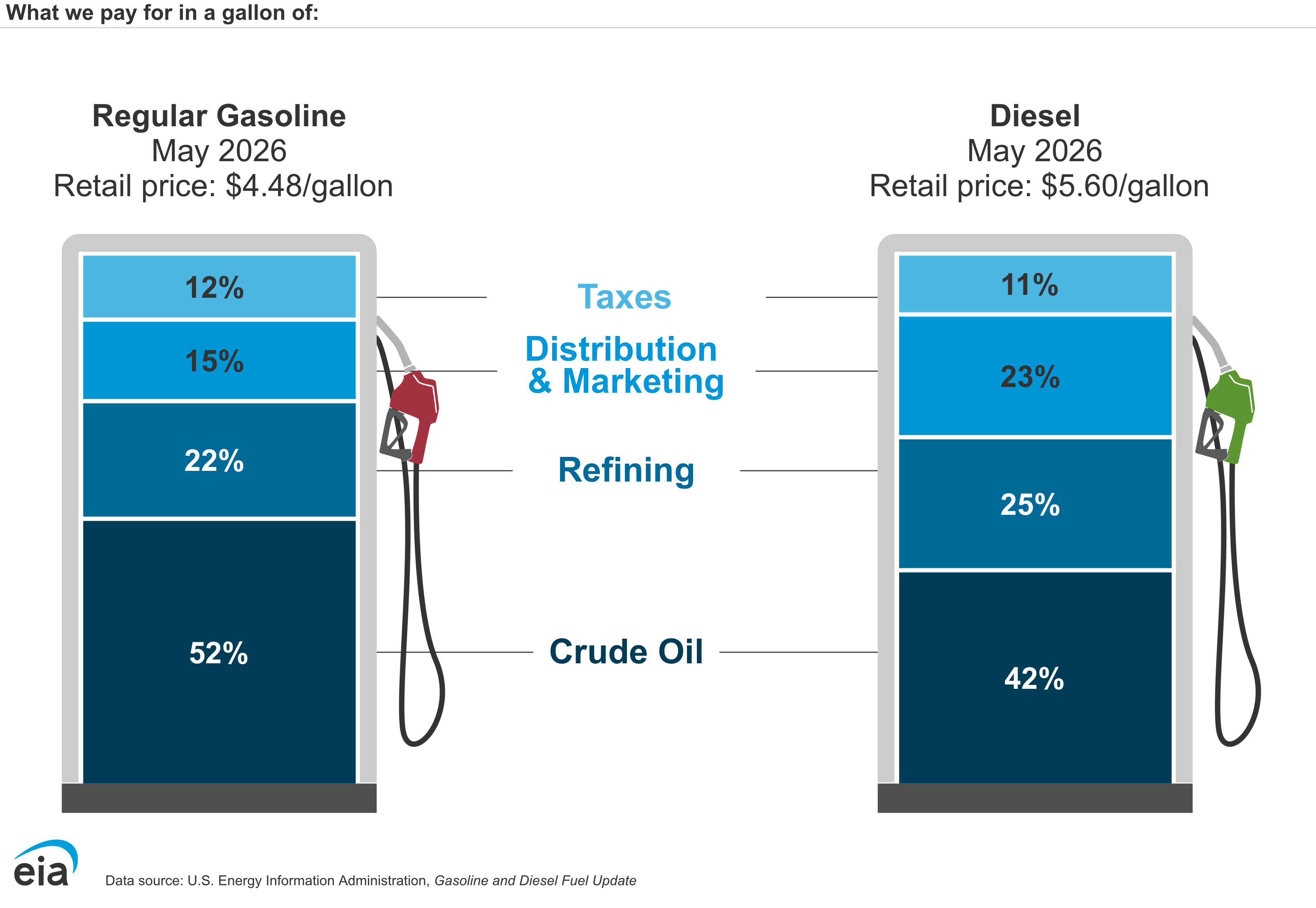
Those shares move with market conditions. Over the longer run, EIA estimates crude oil accounted for about half of the average retail diesel price from 2004 through 2025. Crude therefore remains fundamental to what truckers and families eventually pay.
But today’s diesel problem is also about refining. The latest EIA analysis points to unusually high diesel refining margins combined with elevated crude prices. Global distillate supplies have tightened as refinery disruptions and geopolitical events reduced available supply.
This is what scarcity looks like.
America Is Already Straining Refining
American refiners aren’t sitting around waiting for higher prices.
According to EIA’s September diesel-market analysis, U.S. distillate production averaged about 5.1 million barrels per day from January through August, the highest since 2019. Refinery utilization reached roughly 97% in the week ending September 11.
Yet inventories remained about 13% below their five-year seasonal average.
Meanwhile, global diesel markets have tightened as geopolitical conflicts, refinery disruptions, and reduced exports from important producing regions have collided with already-low inventories.
That context matters because an export ban doesn’t create another gallon of diesel.
It could keep additional gallons in some U.S. markets temporarily. That’s the strongest argument for it. But the more important question is: What happens to production and investment afterward?
Don’t Punish the Supply Response
Refineries are multibillion-dollar investments expected to operate for decades. Investors care about future regulatory costs, input prices, transportation options, and access to customers.
Tell refiners that government may restrict where they sell whenever prices become politically uncomfortable, and policy risk rises. That can reduce expected returns on refinery expansions, upgrades, maintenance, pipelines, terminals, and storage.
My own research helps explain why focusing narrowly on the pump price can mislead policymakers. In a peer-reviewed Energy Economics research on retail and wholesale gasoline prices, we found a strong long-run relationship between crude oil and wholesale and retail gasoline prices, with symmetric long-run adjustment.
Our later Energy Economics study of the retail gasoline supply chain similarly examined short- and long-run price responses and structural breaks. And my more recent research, “Structural Breaks and Long-Run Adjustment in the Diesel Fuel Market,” applies this work directly to diesel.
The broader lesson is simple: petroleum markets are interconnected, and prices adjust to underlying market fundamentals.
So let’s improve those fundamentals!
Make Supply the Strategy
Start with production. America should make it easier to explore, drill, produce, and transport oil. More crude supply matters because, as the EIA data above show, crude remains one of the largest components of diesel prices.
Then tackle refining. If refining represents roughly one-quarter of today’s diesel price, barriers to building, expanding, and modernizing refinery capacity deserve much more attention than restricting exports. Streamline permitting and provide predictable rules so businesses can confidently invest billions of dollars over decades.
Lower the cost of investment, too. Tariffs on steel, aluminum, machinery, and other productive inputs raise the cost of pipelines, refineries, drilling equipment, storage facilities, and other infrastructure. If we want cheaper energy, government shouldn’t make the capital needed to produce it more expensive.
Transportation matters, but it isn’t the central problem. The administration’s temporary Jones Act relief shows why flexibility matters when supplies are tight. Fuel needs to move efficiently between American regions, not encounter artificial transportation barriers.
And pursue peace. When wars damage refineries, disrupt shipping routes, or remove barrels from world markets, Americans eventually feel those disruptions at the pump.
Let Abundance Work
America exported about 2.4 million barrels per day of major transportation fuels in 2025, according to EIA’s analysis of U.S. transportation-fuel trade, with distillates accounting for more than half. Yet distillate exports actually declined from 2024 and remained below 2019 levels.
Exports aren’t the enemy. Scarcity is.
The durable answer is to make producing, refining, transporting, and investing in American energy easier and more profitable.
More production. More refining. More infrastructure. Freer trade. Less government.
Don’t respond to high diesel prices with another government restriction. Remove the barriers to abundance and let people prosper.
Until next time, God bless you, and let people prosper.
Vance Ginn, Ph.D.
President, Ginn Economic Consulting