
Don’t Tax Capital—Or Compute
AI backlash is real, but taxing capital, compute, or machine investment is the wrong answer to a spending-driven fiscal mess.

Hello friends,
A recent debate over AI and tax policy gets at a real political tension, but it points toward a questionable policy fix.
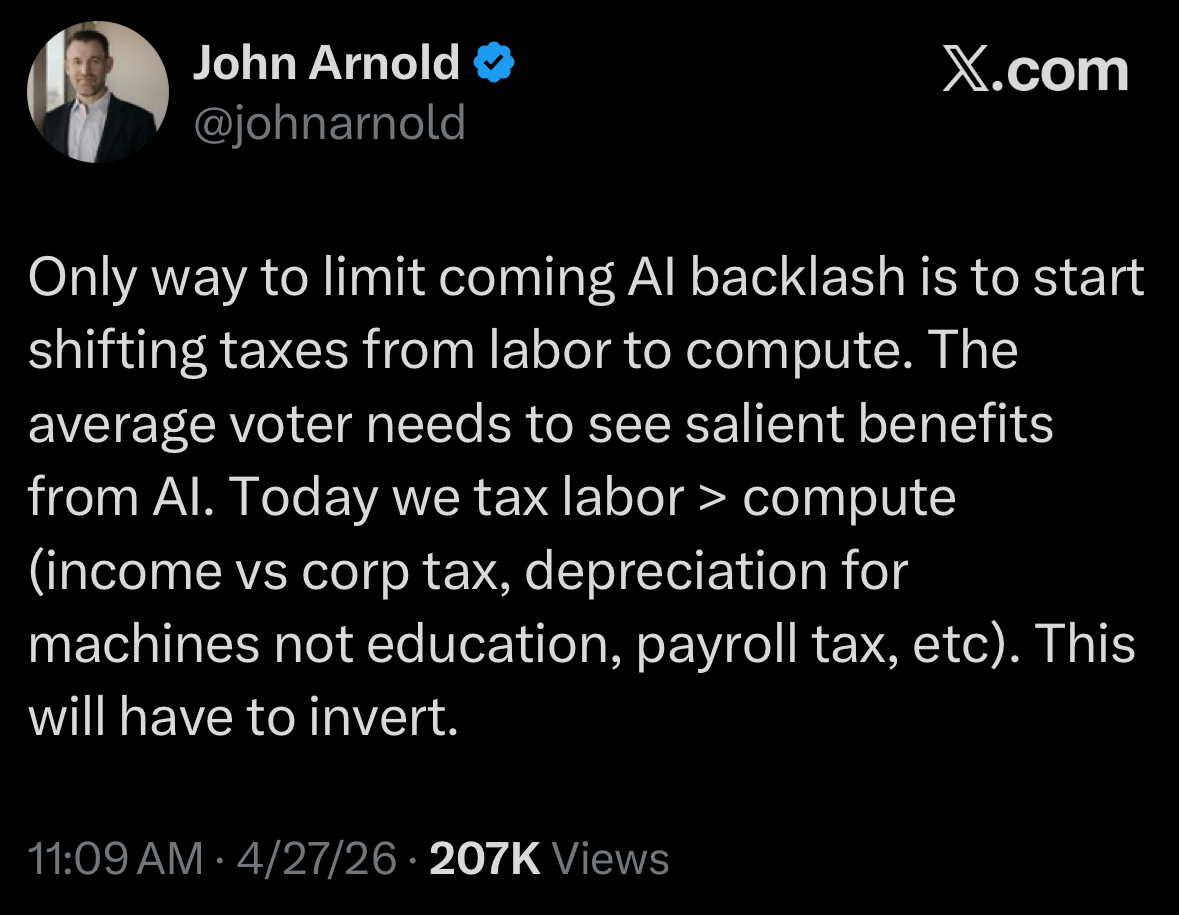
John Arnold argued that the way to limit a coming AI backlash is to shift taxes from labor to compute so average voters see more visible benefits from AI.
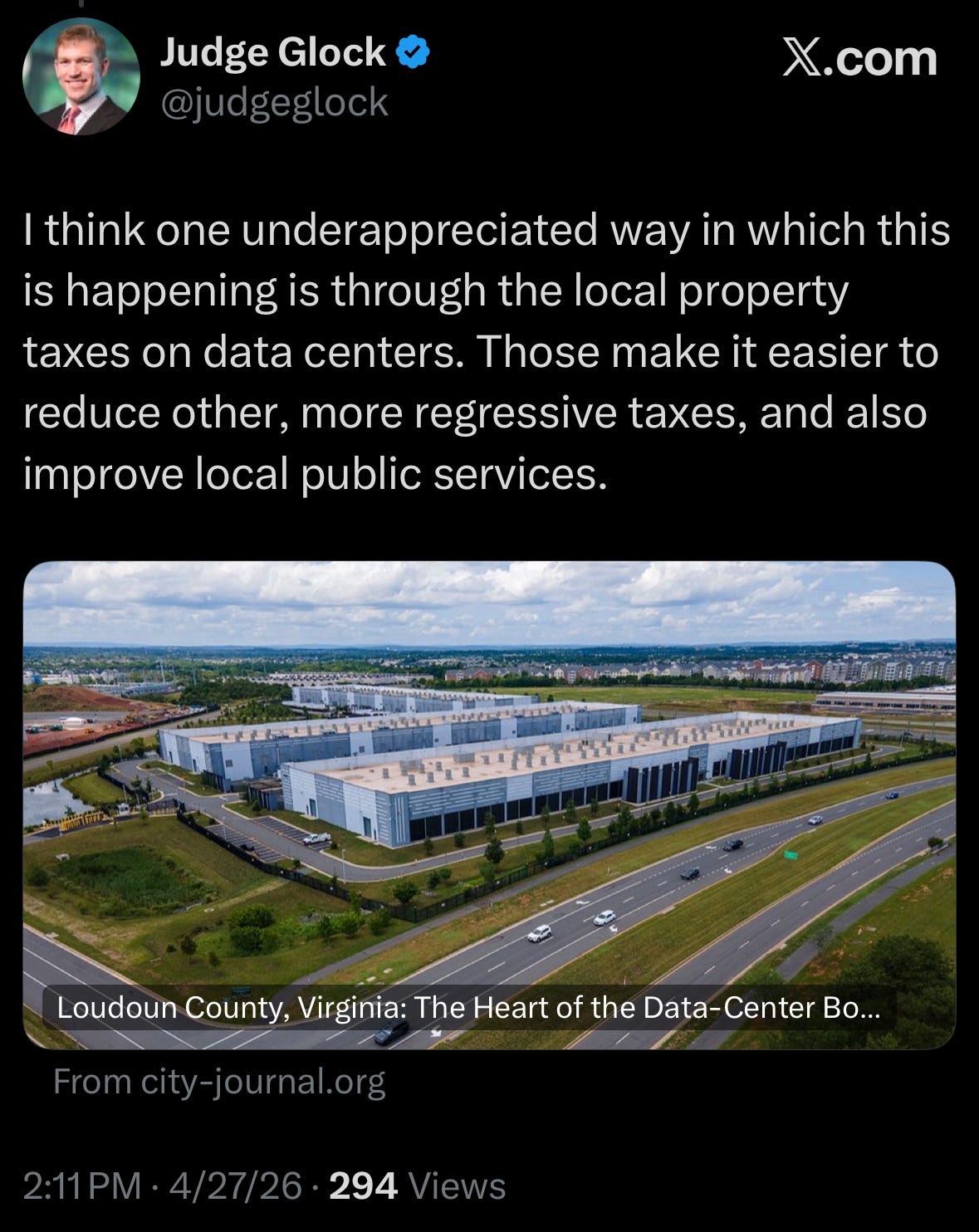
Judge Glock added that local property taxes on data centers can help reduce other taxes and improve local public services.
I understand the concern. If workers believe AI is enriching owners of capital while government keeps taxing work, wages, and human effort more visibly, the politics could turn ugly fast.
But the policy answer still points in the wrong direction.
We should not respond to AI by taxing capital, compute, data centers, or other forms of productive investment more heavily. And we definitely should not pretend that taxing servers, chips, algorithms, or machine-intensive infrastructure solves the deeper problem. It does not. It just shifts the burden, slows innovation, and weakens the direct connection between citizens and the cost of government.
That connection matters in a constitutional republic.
Capital Cannot Pay Taxes
This is the first principle too many people skip.
Capital cannot pay taxes. Compute cannot pay taxes. AI cannot pay taxes. Data centers cannot pay taxes.
People pay taxes.
Workers pay through lower wages. Consumers pay through higher prices. Savers and investors pay through lower returns. Communities pay through weaker investment and slower productivity growth.
The Tax Foundation explains that taxes on capital gains reduce saving and investment and lower long-run output. Cato has made the same point, especially through the lock-in effect, where capital stays trapped in older uses because selling triggers a tax penalty.
That is why taxing compute is just a new version of an old mistake. It treats productive capital as if it were a bottomless source of revenue rather than the engine of higher productivity and better living standards.
If AI is going to help the economy grow, then we should want more investment in the infrastructure, software, chips, and entrepreneurial experimentation that make that possible, not less.
Taxing Inflation Isn’t Justice
This is where the moral case gets even stronger.
The current tax code often taxes inflationary phantom gains as if they were real income. If someone buys an asset at one price and sells it years later at a higher nominal price, a large chunk of that “gain” may simply reflect the dollar losing value. Yet government still taxes it as if it were real wealth creation.
That is not just inefficient. It is unfair.
The Tax Foundation has shown that inflation indexing would stop the tax code from overstating gains and improve neutrality in the treatment of investment. Cato has argued that inflation can drive the effective capital gains tax rate toward absurd levels and that indexing is a meaningful reform even short of repeal.
Congress should do that now.
If lawmakers want to move in the right direction, the first big step is simple: index capital gains for inflation. That would at least stop government from taxing fake gains created by its own inflationary monetary and fiscal disorder.
But that should not be the end point.
The North Star Is Zero
My North Star is no taxes on capital.
That means getting the tax on capital gains to zero as quickly as possible. Indexing is the right near-term step. Zero is the right destination.
Economically, that means more capital formation, more reallocation toward productive uses, more entrepreneurship, and stronger wage growth over time.
The Tax Foundation notes that lower capital gains taxes reduce the tax bias against investment and improve long-run growth.
Cato likewise argues that lower rates reduce lock-in, encourage more productive deployment of capital, and lessen the damage from inflation.
Philosophically, taxing capital is wrong because it penalizes deferred consumption, prudence, and risk-taking. We should not punish people for saving, investing, and building.
Morally, government should not get to claim a share of inflationary asset appreciation while pretending it is taxing real income. That is legalized overreach.
The Real Disease Is Spending
Still, let’s not kid ourselves. The tax base is not the deepest problem.
Government spending is the disease.
Taxes, debt, inflation, and fiscal gimmicks are symptoms of that disease. The Congressional Budget Office projects debt held by the public at about 101 percent of GDP in 2026, rising to 120 percent by 2036, while annual deficits grow from roughly $1.9 trillion to $3.1 trillion. Gross debt is much higher.
Washington is not hunting for new tax bases because labor is mistreated and compute is undertaxed. Washington is hunting for new tax bases because government spends too much and always wants more.
That is why I keep arguing that tax reform without spending restraint is a mirage. If you do not reduce the size and scope of government, politicians will always go searching for a new “fair” thing to tax next.
Today it is capital.
Tomorrow it is compute.
Next week it is AI infrastructure.
After that it is unrealized gains, wealth, land, or something else.
The target changes. The appetite does not.
End Carveouts, Not Innovation
Now, that does not mean the current tax code is fine.
If data centers are getting special exemptions and carveouts, those should be on the chopping block. Special treatment narrows the tax base, fuels cronyism, and invites backlash. Recent Texas Tribune reporting found Texas data-center sales-tax exemptions are projected to reach about $1.6 billion by 2027, with annual totals nearing $1.8 billion by 2030.
So yes, end the carveouts.
But do not replace carveouts with a new punitive tax on compute.
That is not reform. That is just a new distortion.
Keep Taxes Visible
This is why I prefer broad taxation of final consumption of goods and services over hidden taxes on capital, production, and intermediate business inputs.
If government is going to tax, the burden should be visible enough that citizens can feel the cost and discipline the politicians imposing it. That is one reason I have argued in my own work on property tax reform and why Texas can eliminate property taxes that a broader, visible tax on final consumption is more honest and less destructive than taxes on ownership, production, or capital formation.
And no, I do not mean a value-added tax (VAT). A VAT is too easy to hide, too easy to expand, and too disconnected from ordinary taxpayers.
The Better AI Politics
If policymakers really want average voters to benefit from AI, here is the better play:
Stop punishing work.
Stop punishing investment.
Stop subsidizing favored firms.
Stop taxing capital harder.
Index capital gains for inflation now.
Drive the capital gains rate to zero fast.
And reduce government spending so politicians stop hunting for ever-newer tax bases.
That is how you let more people share in growth.
The answer to AI backlash is not more political management of innovation. It is a freer economy, a cleaner tax code, stronger growth, and a government humble enough to stop treating every new productivity gain as a new fiscal target.
Three Takeaways for Policymakers
1. Don’t tax capital, compute, or AI harder.
Those taxes do not stay on machines or servers. They land on people through lower investment, weaker productivity, and slower wage growth, as the Tax Foundation and Cato have both shown.
2. Index capital gains for inflation now and reduce the rate to zero.
Indexing is the right near-term reform because it stops taxing fake gains. Zero is the right long-term destination because capital formation should not be punished. That conclusion is supported directionally by the Tax Foundation’s inflation work, the Tax Foundation’s growth analysis, and Cato’s inflation arguments.
3. Spending is still the disease.
The reason politicians keep looking for new things to tax is that government spends too much. The CBO outlook makes that painfully clear.
The coming AI backlash is real. But the answer is not to tax compute.
The answer is to stop taxing growth, stop taxing inflationary fiction, end the carveouts, reduce spending, and let people prosper.
Thank you for reading, for supporting my work, and for sharing it with others. That support helps me keep providing a North Star for sound policy through Ginn Economic Consulting. I’m also glad to speak at events, join podcast or radio conversations, do media interviews, and meet with policymakers across the country to help advance practical, pro-growth reforms that let people prosper.
Find more of my work at vanceginn.com and subscribe free at vanceginn.substack.com.
Let people prosper,
Vance Ginn, Ph.D., President, GEC
Interesting read. How do you see property taxes going for DCs. That seems to be the most visible way to boost local revenues and give locals a reason not to oppose them. Like it or not, big tech is perceived as having extra money to spare and people want a piece of it for their trouble.