
Hello friends,
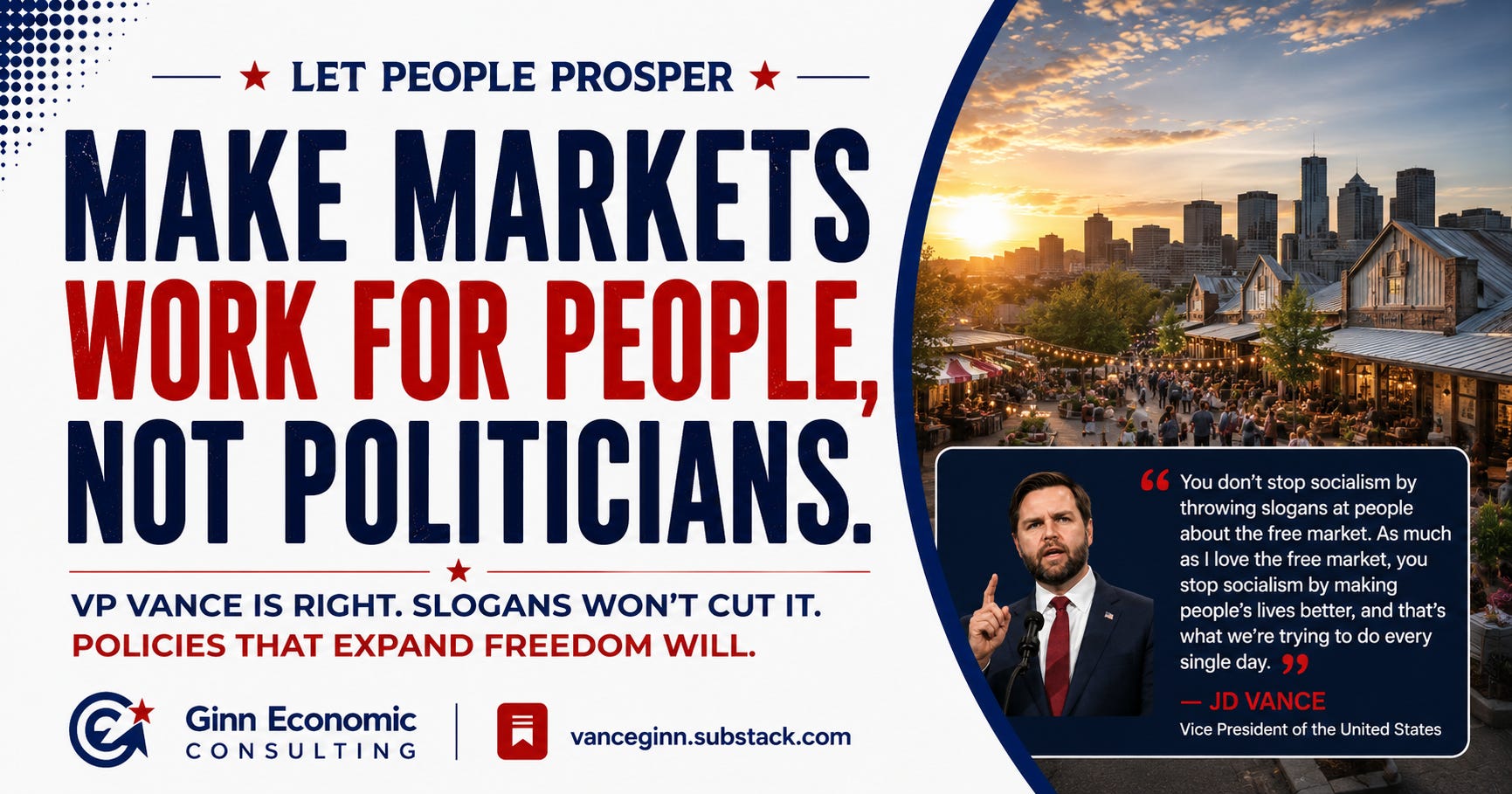
Vice President JD Vance recently put his finger on a political problem policymakers should not ignore.
He is right about the challenge. The question is what policymakers do about it.
Young Americans see homes they cannot afford, healthcare bills they cannot understand, college debt they cannot easily repay, and wages stretched by higher prices. Telling them capitalism is great will not change their minds. Neither will giving government more control.
Government Gets in the Way
Policymakers should ask a simple question: Where are markets failing, and where has government prevented markets from working? That distinction changes the debate.
Take housing. Government limits supply through zoning, permitting delays, minimum lot sizes, fees, and other barriers while Washington subsidizes demand. When too much money chases too few homes, prices rise. The answer is not another subsidy. Let builders build.
Healthcare suffers from a different version of the same problem. Tax preferences, mandates, licensing restrictions, subsidies, and third-party payments separate patients from prices. More mandates layered onto existing mandates will not create competition. Give patients more control over their healthcare dollars and let providers compete for them.
Higher education follows the pattern. Federal subsidies and easy lending increase the money available to pay tuition while accreditation and other barriers limit competition. Policymakers respond to the resulting debt with forgiveness programs, shifting costs to taxpayers rather than fixing the incentives that helped inflate prices.
Government creates distortions and then proposes another government program to fix them.
Economic Freedom Delivers
There is a better way.
The evidence in my recent Kansas Policy Institute analysis overwhelmingly favors economic freedom. The latest Fraser Institute Economic Freedom of the World report finds average incomes in the freest quarter of countries are 6.2 times those in the least free. Among the poorest 10%, incomes are 7.8 times higher. People also live about 17 years longer.
Those numbers matter because economic policy should ultimately be about human flourishing, not simply GDP. GDP measures production. It cannot measure strong families, faith, community, or happiness. Markets do something more fundamental: they give people choices.
A worker can change jobs. An entrepreneur can challenge an established company. A family can decide what to buy. Investors can move capital toward better ideas. Consumers reward businesses that serve them and punish those that do not. Profit and loss provide feedback that government programs rarely receive.
Pro-Market, Not Pro-Business
Policymakers who want capitalism to work better should stop protecting businesses from markets.
End corporate welfare. Reject bailouts. Reduce protectionism. Remove regulations designed to shield incumbents. Restrain spending and taxes that shift resources from families and entrepreneurs toward government. Those policies are sometimes sold as “pro-business.” They are not necessarily pro-market.
Milton Friedman understood the difference. Economic freedom does not promise that every outcome will be equal or every decision wise. It recognizes that millions of people making voluntary choices with their own knowledge and resources will generally allocate them better than politicians spending someone else’s money.
Let People Choose
VP Vance is right that policymakers must show young Americans something better than slogans. So show them.
Make housing easier to build. Put patients in charge of healthcare dollars. Open education to competition. Stop subsidizing favored corporations. Restrain government spending. Lower barriers to work, investment, and entrepreneurship.
Measure success by whether people have more opportunity and more control over their lives.
The strongest answer to socialism is not talking more about free markets. It is letting people experience one.
Let people prosper,
Vance Ginn, Ph.D., President, Ginn Economic Consulting
Let People Prosper is a reader-supported publication. If this analysis is useful, please follow, share, and consider becoming a paid subscriber. Your support helps me produce independent research and commentary advancing economic freedom and human flourishing.