People Chase Freedom
The latest migration data show Americans moving toward lower taxes and greater economic freedom.


Hello friends,
Americans are still voting with their feet, and lawmakers should stop pretending otherwise.
The newest IRS migration data, the latest Tax Foundation migration analysis, the new Fraser Institute economic freedom rankings, and the latest ALEC-Laffer competitiveness index all point in the same broad direction: people and income continue moving toward states with lower taxes, stronger economic freedom, and more competitive policy climates.
That pattern is not random. It reflects incentives, and it carries major implications for tax reform, spending restraint, and long-run state competitiveness.
According to the Tax Foundation’s review of the IRS interstate migration files for tax years 2022 to 2023, 27 states posted a net gain in income tax filers from interstate migration.
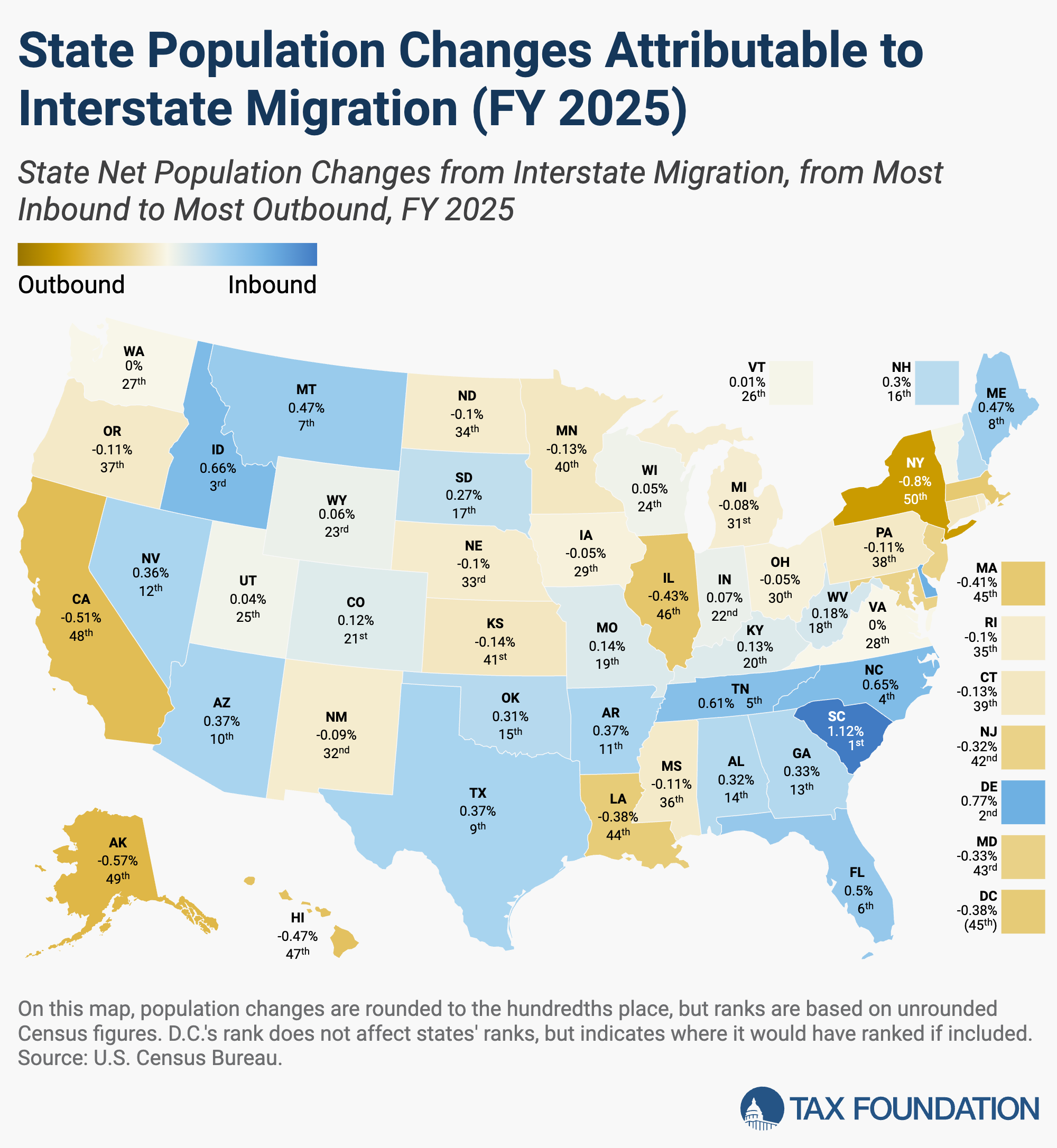
The biggest winners were Texas (+56,473), Florida (+55,359), North Carolina (+39,118), South Carolina (+29,214), Tennessee (+24,104), Arizona (+17,316), Georgia (+14,671), and Colorado (+11,341).
The biggest losers were California (-100,397), New York (-71,987), Illinois (-28,609), New Jersey (-19,370), Massachusetts (-15,378), Maryland (-13,628), and Pennsylvania (-12,095).
This is not just a headcount story. It is an income story too.
The same Tax Foundation analysis found that Florida posted the largest net adjusted gross income gain from interstate migration at about $20.6 billion, followed by Texas at $5.5 billion. Other major winners included South Carolina, North Carolina, Arizona, and Tennessee, each with large AGI gains. On the losing side, California posted a net AGI loss of about $11.9 billion, New York about $9.9 billion, Illinois about $6.0 billion, Massachusetts about $3.9 billion, and New Jersey about $2.55 billion. That matters because states do not just lose people when they lose migration battles. They lose tax base, investment, entrepreneurship, and future growth.
Taxes are not the only factor in where people move. Housing costs matter. Jobs matter. Crime matters. School quality matters. Regulation matters. But tax policy still matters enough that lawmakers ignore it at their own peril. The Tax Foundation’s migration work found a clear negative relationship between top marginal state individual income tax rates and net per-capita migration. That does not mean taxes explain every move. It does mean tax competitiveness remains an important part of the story.
The broader policy environment matters too, and this is where the latest Fraser Institute Economic Freedom of North America report sharpens the case.
In the U.S. subnational index for 2023, New Hampshire ranked 1st, Tennessee 2nd, South Dakota 3rd, Texas 4th, Idaho 5th, Florida 6th, North Carolina 7th, and Georgia 8th. Near the bottom were California 47th, Hawaii 48th, New York 49th, and New Mexico 50th.
Fraser also reports that from 2014 to 2023, population in the freest U.S. states grew 17.7 times faster than in the least-free states, while employment in the freest states grew about twice as fast. In plain English, Americans are not just moving toward lower taxes. They are moving toward better policy ecosystems overall.
The new ALEC-Laffer Rich States, Poor States 2026 report reinforces that point from a different angle.
Its forward-looking Economic Outlook Rankings place Utah 1st, Tennessee 2nd, Idaho 3rd, North Carolina 4th, Arizona 5th, Florida 10th, Texas 13th, and Georgia 14th, while California 47th, Vermont 48th, New Jersey 49th, and New York 50th sit at the bottom.
ALEC’s backward-looking Economic Performance Rankings for 2014–2024 also show many migration winners near the top, including Florida 1st, Arizona 2nd, Idaho 3rd, Utah 4th, South Carolina 6th, Texas 7th, North Carolina 9th, and Georgia 11th.
These rankings are not perfect, and no single index explains everything. But they tell a consistent story: states with stronger growth-oriented institutions tend to outperform over time.
This is one reason the flat-tax revolution matters. As the Tax Foundation’s flat-tax review has highlighted, the last several years have seen a remarkable wave of states adopting flatter income taxes and lower rates. North Carolina was an earlier mover, and as of January 1, 2026, its individual income tax rate fell from 4.25 percent to 3.99 percent. South Carolina has now enacted a path to zero, and several other states have adopted flat taxes or set future triggers for more reform. That kind of reform matters because it improves incentives at the margin and sends a broader message: this state wants to be more competitive, more pro-growth, and less punitive toward work and investment.
Too many lawmakers in high-tax states still explain away out-migration as a weather story, a retirement story, or a temporary post-pandemic adjustment. That is wishful thinking.
If taxes and economic freedom did not matter, states would not keep cutting rates, flattening tax codes, and competing harder for residents and employers. If policy did not matter, the winners and losers would look much more random than they do.
Instead, the same broad pattern keeps appearing: lower-tax, more economically free states keep attracting people and income, while higher-tax, less economically free states keep losing both. That should be a warning to policymakers who think they can fund larger budgets forever on a shrinking base.
The deeper lesson is not merely “cut taxes.” It is “build a more competitive institutional framework.”
That means lower and flatter taxes. It means spending restraint so tax relief lasts. It means broader and simpler tax bases instead of carveouts and complexity. It means reducing unnecessary regulation, making housing more attainable, protecting work and entrepreneurship, and creating a governing climate that trusts people more than bureaucracies.
The Fraser and ALEC rankings are not identical, but both underscore the same truth: growth tends to follow policy environments that leave more room for people to work, invest, hire, build, and move up.
That is why I keep coming back to the same North Star: let people prosper.
If lawmakers want a reality check on whether their policies are working, they should look at where people are choosing to go, where income is flowing, and where opportunity is expanding. Americans are sending a clear signal. The question is whether policymakers are willing to hear it.
Three Takeaways for Policymakers
1. Americans are still voting with their feet.
The latest IRS migration release and Tax Foundation analysis show strong net filer gains in states like Texas, Florida, North Carolina, South Carolina, and Tennessee, while California and New York remain major losers.
2. People are moving toward broader economic freedom, not just lower taxes.
The latest Fraser Institute report ranks Texas 4th, Florida 6th, North Carolina 7th, and Georgia 8th in U.S. economic freedom, while California and New York rank near the bottom. The ALEC-Laffer index tells a similar story on both outlook and performance.
3. Competitive tax reform should continue, but it should be paired with broader reform.
Flatter taxes and lower rates help, but durable growth also requires spending restraint, a lighter regulatory touch, and a policy environment that rewards work, investment, and entrepreneurship.
The migration data do not tell us everything. But they tell us enough.
People are moving toward opportunity, affordability, lower taxes, and more economic freedom. States that want to grow should take the hint.
Thank you for reading and for sharing my work. If this added value to your week, please pass it along to a policymaker, staffer, journalist, or friend who should read it.
If your organization, state, or team needs help thinking through tax reform, spending restraint, competitiveness, or broader pro-growth policy, I would be glad to help through Ginn Economic Consulting. I am also glad to speak at events, join interviews and podcasts, and meet with policymakers across the country.
Find more of my work at vanceginn.com and subscribe at vanceginn.substack.com.
Let people prosper,
Vance Ginn, Ph.D.
President, Ginn Economic Consulting