
Texas Property Taxes Problem
Relief is not enough when spending keeps growing faster than taxpayers can afford and people can’t own homes.
Hello friends,
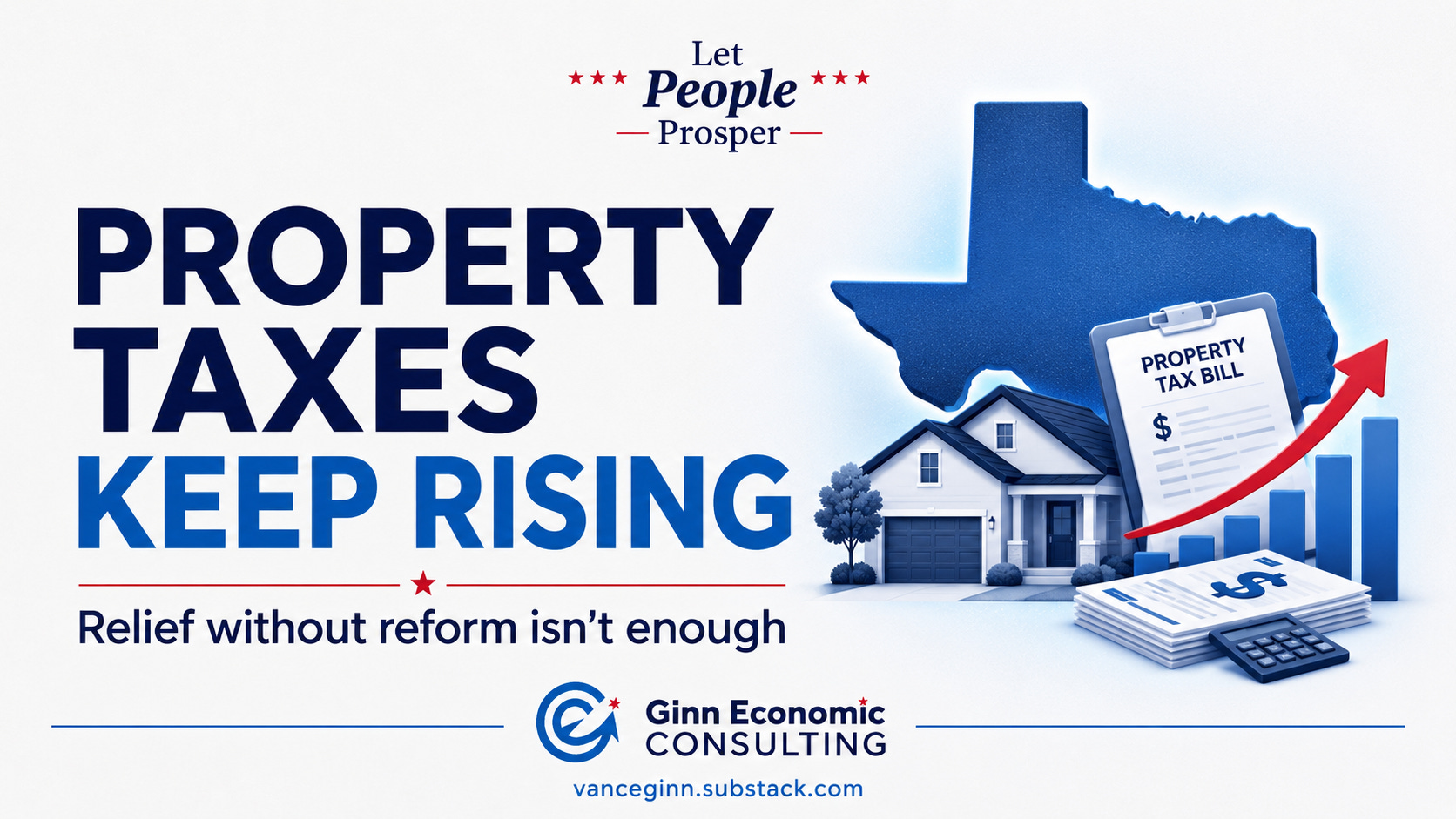
Today is the usual deadline for Texans to protest their appraised property values, and there is no mystery about why so many families are frustrated. They have heard lawmakers talk about “historic property tax relief” for years, yet their bills keep climbing.
That is why I wrote my latest piece in the Houston Chronicle: Texas should stop pretending partial relief is the same thing as structural reform.
Here is the core problem: Texas does not lack revenue. Texas lacks hard limits on government spending.
Relief Without Reform Is Not Enough
In the piece, I argue:
“The problem is not that Texas lacks the tax revenue to cover state needs or the policy tools to address the problem.”
That is exactly right. Texas has had massive state surpluses. State leaders have cited roughly $51 billion in property tax relief. Yet total local property tax levies still rose to $89.4 billion in 2025, up 22 percent since 2021.
That is not success. That is a warning sign.
If the state spends billions trying to provide relief, but local governments keep increasing levies, Texans are not getting real reform. They are getting a shell game. One hand reduces rates or expands exemptions. The other hand keeps growing government.
And homeowners get stuck with the bill.
Property Taxes Are a Moral and Economic Problem
Property taxes are not just another line item. They strike at the heart of ownership.
As I wrote:
“Government is not meant to permanently claim a share of what people own.”
That is the moral issue. If you have to keep paying the government forever just to stay in your home, then ownership is never truly secure. You may hold the deed, but the government holds a permanent claim.
That is especially harmful for seniors on fixed incomes, young families trying to buy their first home, renters whose landlords pass along tax costs, and small businesses trying to survive higher overhead.
Property taxes are often defended as stable. But they are stable for government, not taxpayers. They rise even when income does not. They punish people for improving their homes. They push families out of neighborhoods they helped build. And they make housing affordability worse in a state already struggling with high costs.
The Place to Start Is School M&O Taxes
The most logical place to start is school district maintenance and operations property taxes. They are the largest share of the property tax burden, and public education is already largely shaped by state formulas, mandates, compression, and recapture.
As I explain in the Chronicle:
“If the state largely controls the system, it should fund it directly rather than forcing homeowners to pay a perpetual tax on homeownership.”
That means funding government school operations without punishing property ownership.
The state can eliminate school M&O property taxes through a surplus buydown approach. The idea is simple: limit state spending growth to less than population growth plus inflation, then use surplus revenue above that limit to compress school M&O tax rates until they reach zero.
This is not some fantasy. I have been working on this framework for years, including testimony showing Texas could substantially reduce school property taxes by restraining spending and using surpluses for compression.
The Sales Tax Argument Is Overstated
Some argue eliminating school property taxes would require a massive sales tax hike. I do not buy it.
A broader sales tax base focused on final consumption for the 21 century, combined with real spending restraint, could replace school district M&O property taxes with a rate no higher than 9 percent, compared with today’s combined state and local rate of 8.25 percent.
The key is not simply the tax rate. The key is spending discipline.
A broader sales tax should not become a new revenue machine. It should be tied directly to permanent property tax rate reduction. Otherwise, lawmakers will do what they usually do: collect more, spend more, and call it reform.
Local Governments Must Do Their Part
The state should work to eliminate school district property taxes. Cities, counties, and special districts should eliminate their own property taxes through the same principle: spending restraint first, surplus buydown second.
Local governments should face hard limits based on the maximum of population growth plus inflation, with zero-growth levy rules unless voters approve more by a supermajority. Without that, local spending will continue to erase state relief.
The spending problem is not hypothetical. Texas local governments had $257 billion in tax-supported debt at the end of fiscal 2025. That debt matters because voter-approved debt should remain local and be repaid by the voters who approved it. The state should not socialize local debt across taxpayers who never consented to it.
Education Needs Better Incentives, Not Just More Money
One common objection is that school property taxes cannot be reduced because education needs more funding. But Texas public education spending has already grown significantly. The Texas Education Agency reports annual funding per student has risen 53 percent over 11 years.
If money alone produced great outcomes, Texas would already be leading the world.
The problem is not too little spending. The problem is too much bureaucracy, weak competition, and poor incentives. Texas should fund students better, empower parents, expand education freedom, and demand results. Higher property taxes are not a substitute for accountability.
The Bottom Line
Texas can eliminate property taxes. It can do it gradually through surplus buydowns or more quickly with a broader, more modern sales tax base tied to strict spending limits.
But it cannot do it while pretending exemptions are enough. It cannot do it while local governments keep raising levies. And it cannot do it if lawmakers keep treating every surplus dollar as permission to spend more.
Texas once led the nation by pairing low taxes with disciplined spending. It can lead again.
But leadership requires more than relief. It requires courage.
Read my full Houston Chronicle piece here: Sick of paying property taxes? Here’s how Texas can just eliminate them.
Three Takeaways for Policymakers
Stop confusing relief with reform.
Homestead exemptions and temporary compression help, but they do not fix the spending structure that keeps property taxes rising.Use surplus buydowns to eliminate school district M&O taxes.
Limit spending growth to population growth plus inflation and dedicate surplus revenue to permanent rate compression.Require local spending discipline.
Cities, counties, schools, and special districts should not be allowed to erase state relief through higher local levies and debt.
Please share this with a Texas homeowner, lawmaker, staffer, or local official who needs to hear it.
Let people prosper,
Vance Ginn, Ph.D.
President, Ginn Economic Consulting
Former Chief Economist, Trump 45 White House OMB
More of my work: vanceginn.com