
Why Do We Have An Affordability Crisis? | This Week's Economy Ep. 154
From turning local banks into spies to scapegoats in the housing crisis—policy choices matter.

Hello Friends,
What’s on Americans’ minds? The latest primary election results offered a window into what voters are thinking about. In my home state of Texas, voters sent a clear signal by backing efforts to eliminate property taxes through spending reductions.
Across the country, Americans are asking for the same things: lower taxes, a more affordable future, and a strong economy that creates opportunities. But too often, policymakers try to tax their way out of spending problems or regulate innovation — choices that threaten the very prosperity people are asking for.
That’s why in This Week’s Economy, I’m breaking down how these issues are playing out in policy debates. From tariffs and taxes to government spending and regulation, these decisions directly shape whether American families can afford the future they’re working toward — and policymakers can’t afford to ignore them.
Let’s dive in! Catch the full episode on YouTube, Apple Podcast, or Spotify, and visit vanceginn.com for more info about my work at Ginn Economic Consulting.

ECONOMIC HEALTH CHECK: How is America’s economy really doing?
In the News:
The February jobs report by ADP showed the labor market remaining in what economists describe as a “low-hire, low-fire” state, with unemployment holding steady. The private sector added 63,000 jobs in February. At the same time, another striking trend is emerging: for the first time since the Great Depression, more people moved out of the United States than moved in. American citizens are emigrating in record numbers. Sources: CNBC and Wall Street Journal
What That Means For You:
Looking Behind the Jobs Report:
It’s encouraging to see private sector job growth, but the details matter. Most of the hiring came from just two sectors—health services and construction—while many other industries were flat or declined.
Weaknesses in today’s labor market reflect policy mistakes made in recent years. The destructive lockdowns of 2020, massive bailout spending, and excessive monetary expansion disrupted labor-market institutions and created lasting distortions. What we are seeing now is the delayed, compounding effects of those decisions.
American Emigration on the Rise:
There are many reasons people leave the United States, but economic concerns are increasingly part of the story. For generations, the United States has been the destination for those pursuing the “American Dream.” But when Americans themselves begin leaving in greater numbers, policymakers should take notice. Maintaining a strong economy that attracts talent and opportunity requires returning to the pro-growth policies that made the United States a magnet for prosperity in the first place.
Steps to Improve the Labor Market
When Washington overspends, overregulates, and tries to micromanage the economy, job creation slows. A stronger labor market requires restoring fiscal discipline. That starts with spending cuts and a sustainable spending limit tied to population growth plus inflation—a rule that enforces accountability, protects taxpayers, and supports long-run economic prosperity.
Related Reading: I break down the reasons for a weak labor market in my commentary on the affordability crisis.

FEDERAL POLICY: State of the Union and Tariffs
In the News:
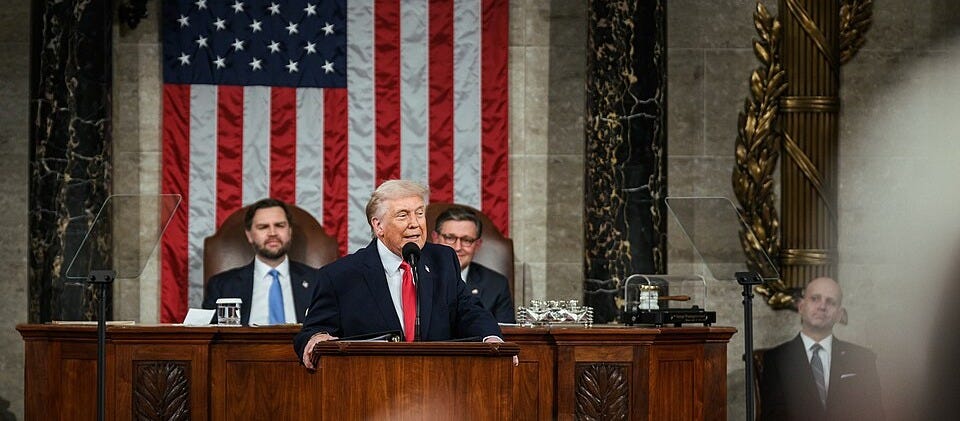
President Trump recently delivered the longest State of the Union address in modern history, defending his first year back in office. He highlighted his record on immigration, the economy, tariffs, and other priorities. Just days earlier, the Supreme Court ruled 6–3 that the emergency statute being used did not authorize the administration’s sweeping tariffs. Sources: New York Times and CBS News
What That Means For You:
A Confident State of the Union Tone — But What About the Policy?
It was refreshing to hear a president speak as if America can still build big things, lead globally, and win the future. Confidence matters. But confidence alone is not a governing strategy. If we want a booming America, we need a forward-looking abundance agenda. That means Washington should stop making life harder and start getting out of the way. Cut and cap government spending. Offer broad-based tax relief. Deregulate production across the economy. Make a clean break from tariffs and price controls. And pursue a sound money policy that protects purchasing power.
The Supreme Court Checks Tariff Power:
In its 6–3 decision, the Court did not weigh in on whether tariffs are good policy. It ruled on who has the authority to impose them. The Constitution gives Congress — not the executive branch—the power to tax and regulate trade. This decision is a win for checks and balances and for constitutional accountability. Trade policy should not hinge on unilateral executive action. Major tax decisions belong with the legislative branch.
What Washington Should Do:
Congress should treat the Court’s ruling as both a warning and an opportunity. Lawmakers should stop outsourcing tariff authority and establish clear guardrails to prevent sweeping tariffs from persisting without direct legislative approval.
If policymakers are serious about affordability and economic resilience, they should reject tariff taxes, block executive shortcuts, and focus on pro-growth reforms: expanding energy supply, reducing spending, and removing barriers to production and competition.
Related Reading: Read my full analysis of President Trump’s State of the Union address here:

STATE POLICY: Property Tax Progress

In the News:
Amid rising property tax bills, Ohio is considering a shift toward taxing land rather than total property value through Senate Joint Resolution 7. Meanwhile, momentum is building in Florida to eliminate most homestead property taxes. The Florida House has already passed legislation that could lower homeowners' costs by thousands of dollars annually, though the measure must still clear the Senate. Sources: Ohio Capital Journal and Newsweek
What That Means For You:
Property Taxes Undermine Ownership:
Property is the foundation of liberty. Taxing it year after year weakens the very concept of ownership, effectively turning homeowners into perpetual tenants of the state. As property assessments rise — often far faster than incomes — families can find themselves priced out of homes they already “own.” That’s why a growing number of states are reconsidering whether property taxes are the right way to fund government. This legislative cycle presents a real opportunity for reform.
Spending Reform Empowers Tax Reform:
In Florida alone, local governments collect more than $55 billion annually in property taxes — and those collections have grown far faster than population and inflation. That growth reflects a spending problem as much as a tax problem.
Lasting property tax relief must begin with disciplined budgeting. Limiting the growth of government spending creates the room to responsibly reduce — or even eliminate — property taxes while protecting core services.
Consider Consumption-Based Taxes Instead:
States should consider redesigning their tax systems around consumption rather than ownership. A broad-based, neutral sales tax applied to final goods and services is generally more transparent, more stable, and less harmful to economic growth than property taxes. When paired with responsible spending limits, this approach can fund essential services while ending the moral and economic distortions created by taxing property — without increasing overall tax revenue.
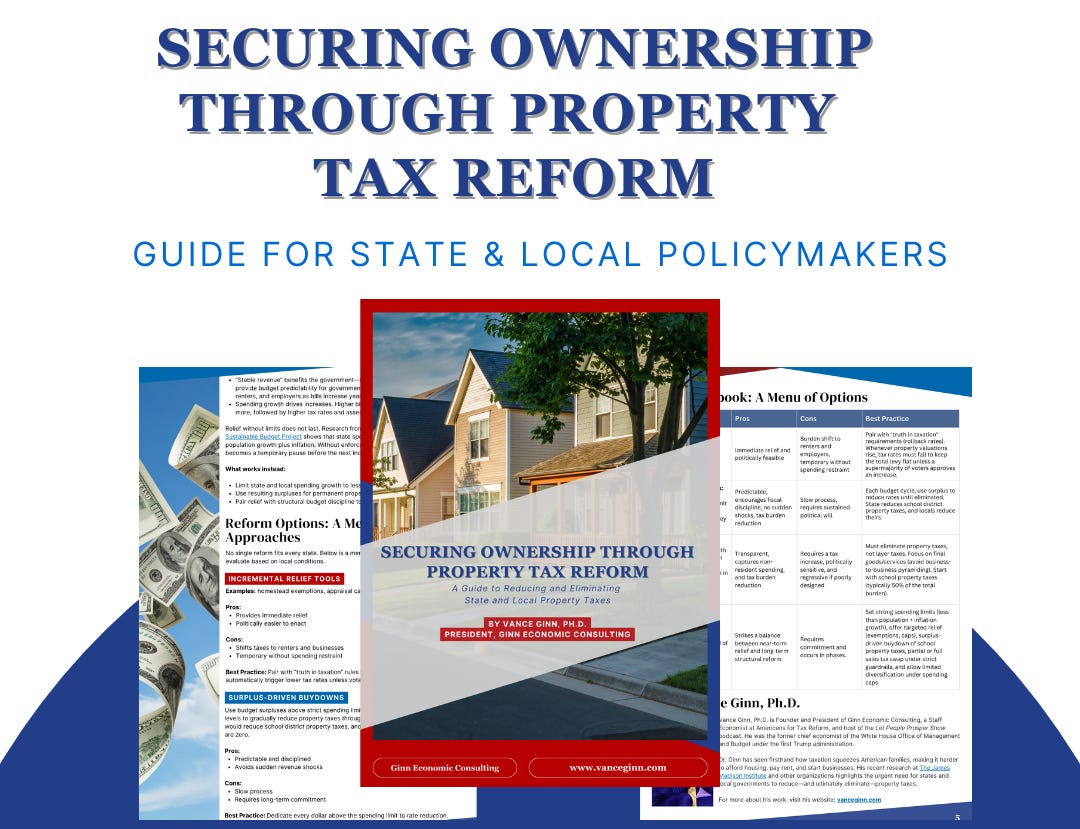
Related Reading: For a deeper look at how states can responsibly pursue property tax reform, check out my guide for state and local policymakers.
BANKING: Local Banks Turned Spies

In the News:
Recent reports indicate that the Trump administration is considering an executive order or Treasury action requiring banks to collect customers’ citizenship information. The requirement could extend to existing account holders — not just new customers — and may include collecting documentation such as passports. Sources: The Washington Post
What That Means For You:
Not a Substitute for a Functioning Immigration System:
The stated goal may be to address illegal immigration and strengthen enforcement. But this proposal treats banks as a substitute for a functioning immigration system. Washington’s failure to consistently enforce immigration laws does not justify shifting that responsibility onto financial institutions — or onto law-abiding Americans. Expanding government reach into private financial relationships is not a solution to immigration policy failures. Offloading enforcement costs onto banks is another way politicians shift blame while hiding the price tag.
The Harmful Impacts to Banks and Customers:
This sweeping expansion of federal data collection would raise compliance costs for banks and make it harder to open accounts, burdening customers. Banks would need new systems, new staff training, new vendors, expanded audits, and new processes to handle documentation gaps and disputes. These compliance costs get passed on to customers in higher fees, fewer low-cost account options, and reduced service — particularly for lower-income and marginal customers. More friction in opening or maintaining accounts means less access to the financial system and a greater risk of pushing activity into the shadows.
Serious Privacy Concerns:
This proposal would require financial institutions to collect and transmit large amounts of highly sensitive personal information. The larger the dataset, the larger the target. More collection and more transmission create more points of vulnerability — raising the risk of data breaches, internal misuse, and mission creep. Once the federal government builds the infrastructure for expanded data collection, it rarely limits its use to the original justification.
Related Reading: Read my recent Fox News commentary on how this proposal punishes the compliant while expanding government reach.

HOUSING: Solving the Affordability Crisis

In the News:
Washington is attempting to tackle the housing affordability crisis by targeting institutional investors. The White House recently issued an executive order titled “Stopping Wall Street from Competing with Main Street Homebuyers,” and lawmakers in the Senate are advancing similar proposals aimed at restricting large investors from purchasing homes.
Two major Senate efforts are underway. Senators Josh Hawley and Jeff Merkley have introduced a bipartisan bill to prohibit large institutional investors from purchasing single-family homes, townhouses, and condos. Meanwhile, Senate Democrats have proposed the “American Homeownership Act,” which would target so-called “Wall Street landlords” by removing certain tax benefits and redirecting those funds elsewhere. Sources: The White House and CBS News
What That Means For You:
The Real Problem Is a Supply Shortage:
America simply did not build enough homes for decades. A widely cited estimate from the National Bureau of Economic Research finds that if housing growth from 2000–2020 had matched the pace from 1980–2000, the U.S. would have roughly 15 million more housing units today. That shortfall — not investor ownership — is the core driver of higher prices.
Who Is Really to Blame?
Institutional investors are not the root cause of unaffordable housing. The primary problem is a government-created housing shortage.
The biggest barriers to new supply are not on Wall Street but at City Hall. Local governments control zoning, density restrictions, parking minimums, minimum lot sizes, height limits, and layers of neighborhood veto power. These policies often make it illegal or financially infeasible to build the type of housing families need, where they need it. When supply is constrained by law, prices rise. That’s basic economics.
These Bills Could Backfire:
Single-family rentals act as a pressure valve for families who are not ready to buy, cannot afford a large down payment, or are priced out by high interest rates. When housing supply is tight, rentals in good neighborhoods can be a lifeline. By shrinking the single-family rental market, there will be less rental supply, higher rents, fewer options near strong school districts, and reduced mobility for working families. If Congress insists on intervening, lawmakers should be careful not to detonate a functioning segment of the housing market while ignoring the real constraint: too little supply.
Related Reading: For my deep dive on this topic and what Congress can do, check out my new commentary.

Thanks for joining me in this episode of "This Week's Economy." For more insights, visit vanceginn.com and get even greater value with a paid subscription to my Substack newsletter at vanceginn.substack.com.
God bless you, and let people prosper!
P.S. - Don’t miss my latest report co-published with NetChoice. The future of American innovation relies on restoring first principles to antitrust policy.


