
Why Affordability Is the Defining Issue of 2026 | This Week's Economy Ep. 152
The data behind rising costs and the pro-growth path forward.

Hello Friends,
Affordability may be the defining word of 2026. After years of elevated inflation, a housing affordability crisis, and signs of softness in the labor market, many Americans are feeling squeezed—and looking for answers. You can expect this issue to loom large at the polls in November. That’s why state and federal lawmakers should confront one of the central drivers of this “unaffordable” economy: fiscal irresponsibility. Persistent overspending helps fuel inflation and adds uncertainty that holds back growth. It’s time to get serious about sustainable budgeting and pro-growth policies that expand opportunity—so Americans can find well-paid jobs, secure affordable housing, and afford daily life again.
In today’s This Week’s Economy, I take an honest look at the latest economic data—even where it challenges media narratives. We’ll also examine the risks of a rising push for social media bans and why energy abundance is essential to powering our technological future.
Let’s dive in! Catch the full episode on YouTube, Apple Podcast, or Spotify, and visit my website for more information.

ECONOMIC HEALTH CHECK: Is Inflation Finally Easing?

In the News:
The latest Consumer Price Index shows prices rose 2.4% annually in January—lower than some expected. Combined with the January jobs report, outlets like The Wall Street Journal are hinting at a possible “soft landing,” pointing to slowing inflation, a stable labor market, and steady growth. Sources: Wall Street Journal and CNBC
What That Means For You:
Too Early to Celebrate the CPI: Can we put inflation behind us? Not yet. The inflation beast hasn’t been slain. The CPI—which measures prices of many goods and services that the average urban household purchases without correcting for substitution bias—shows annual inflation moderating to 2.4%, the lowest since February 2021. The core CPI, which excludes food and energy, that we all purchase, is 2.5% over the last year, 25% above the Federal Reserve’s 2% inflation target.
The Phillips Curve Myth: The theoretical inflation-unemployment tradeoff—the “Phillips Curve”—has never held up well in practice. While the headline unemployment rate remains low at 4.3%, cracks are forming beneath the surface. A troubling divide is emerging between large and small firms. Big companies are gaining market share and managing higher costs with pricing power. Small businesses face tighter margins, higher financing costs, and more hiring challenges. That means fewer options for workers and greater dependence on large employers.
Free-Market Solutions: We need a pro-growth policy shift. Policymakers should stop favoring large firms through subsidies, targeted incentives, and regulatory complexity that smaller businesses can’t absorb. Stable fiscal and monetary rules, lower barriers to capital formation, and less interference would reduce uncertainty and allow businesses of all sizes to compete and grow.
Related Reading: For a deeper understanding of warning signs in the labor market with a growing divide between small and large firms, check out my commentary here.

FEDERAL POLICY: National Debt on Pace to Crush World War II Record

In the News:
“Affordability” is top of mind for many Americans. The cost of goods, housing, healthcare, and everyday services continues to rise. The major driver: Washington’s failure to exercise fiscal discipline, which has pushed the national debt to nearly $39 trillion. At this pace, debt as a share of GDP is projected to surpass the post-World War II record within 4 years. Within a decade, annual budget deficits are expected to hit $3 trillion, according to the Congressional Budget Office. Sources: The Hill and Fox Business
What That Means For You:
Acknowledge the Problem — and Fix It: When the Federal Reserve buys Treasury debt and expands its balance sheet, it effectively increases the money supply. Too much money chasing too few goods erodes purchasing power. Congress must confront overspending directly and commit to restoring fiscal discipline—for today’s families and future generations.
A Sustainable Budget Framework: Sustainable budgeting caps spending growth at the historical average of population growth plus inflation and returns surpluses to taxpayers. Colorado’s Taxpayer Bill of Rights (TABOR) offers a working example. By limiting spending growth and requiring voter approval for tax increases, TABOR has restrained government expansion, refunded surpluses, and supported economic growth—even amid political shifts.
Review Spending and Reform Entitlements: A large share of federal spending is driven by “entitlement” programs such as Social Security, Medicare, and Medicaid. Reforms like personal accounts for savings and/or healthcare spending, gradual age adjustments, means-testing, and eliminating inefficient programs can help protect the most vulnerable while easing pressure on taxpayers. Shifting certain welfare programs to block grants would also allow states to tailor solutions to their economies rather than relying on one-size-fits-all federal mandates.
Related Viewing: My deep-dive episode on federal spending outlines practical principles to address Congress’s fiscal habits and put the country on a path toward lasting prosperity.
STATE POLICY: Latest Employment and GDP Numbers
In the News:
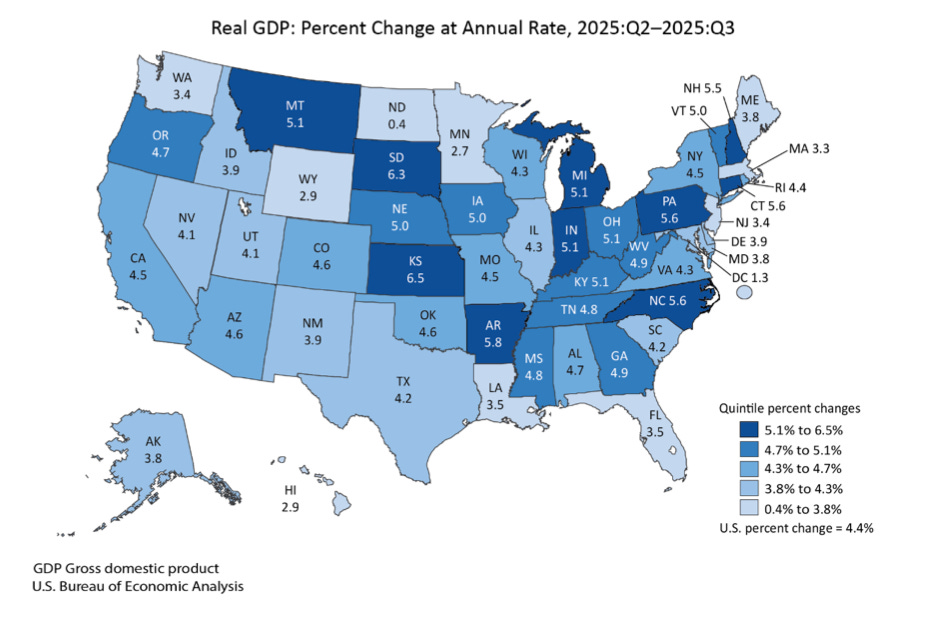
New state-level economic data from the latest jobs and GDP reports show a mixed but generally expanding economy. In December 2025, the national unemployment rate was 4.4%, with state rates ranging from 2.2% in Hawaii and South Dakota to 6.7% in the District of Columbia. In the third quarter of 2025, real GDP and personal income rose in all 50 states and the District of Columbia. Nationally, real GDP grew at an annual rate of 4.4%, led by Kansas at 6.5%, while North Dakota posted the slowest growth at 0.4%. Current-dollar personal income increased at a 3.3% annual rate nationwide, ranging from 6.3% in Kansas to just 0.1% in Louisiana. Sources: Bureau of Labor Statistics, Bureau of Economic Analysis
What That Means For You:
Labor Market Growth: States should closely track labor force growth—especially compared to their neighbors—because outcomes reflect policy choices. States with limited government, disciplined spending, lower taxes, and lighter regulatory burdens tend to create environments where businesses expand, startups form, and jobs grow across sectors. Growth doesn’t happen by accident; it follows incentives.
What GDP Reflects: States like Kansas posted standout real GDP growth last quarter, yet their labor market performance was more modest. Why? Because one strong quarter isn’t a long-term strategy. Hiring decisions are based on expectations—what businesses anticipate about future taxes, spending growth, regulation, and energy costs. Employers respond to stability and predictability, not temporary surges.
Nationwide Trends: Nationally, the labor market has largely stalled since 2022, and real wage gains have been slow to recover. Average weekly earnings are only now returning to levels seen in early 2021. Families still feel the squeeze. States that want stronger outcomes must cap spending growth, use surpluses to reduce tax burdens, and allow workers and producers to keep more of what they earn.
Related Reading: I break down what this data means specifically for Kansas at the Kansas Policy Institute.

TECHNOLOGY: Social Media Bans Gaining Steam

In the News:
A growing number of state lawmakers believe they’ve identified the culprit behind rising teen anxiety and depression: the smartphone. States including Wisconsin, Colorado, Georgia, South Dakota, Alabama, Florida, and Virginia are considering bills that would require app store–level age verification systems (through platforms like Apple or Google) as a frontline response to youth mental health concerns. But as The Economist cautions, “Youngsters have a right to share in new technologies. Adults must seek to make their time online as safe and as rewarding as possible.” Other Sources: Alabama Reflector, Wisconsin Public Radio
What That Means For You:
Is The Anxious Generation Enough to Justify Policy? Much of the legislative momentum traces back to Jonathan Haidt’s The Anxious Generation, which argues that smartphones and social media have rewired childhood and fueled a mental health crisis. It’s a compelling narrative—but incomplete. Correlation is not causation. Crafting sweeping public policy around a single explanatory variable—“the phone did it”—risks oversimplifying a complex cultural problem.
Privacy, Speech, and Competition Risks: These proposals would require app stores to implement age-verification systems that could involve digital IDs, sensitive data collection, and centralized permission frameworks. That raises serious privacy and free-speech concerns. Age verification at scale typically requires collecting and storing personal data—yet data breaches are routine. Courts have also historically scrutinized laws that chill lawful access to constitutionally protected speech. There’s also a competition issue: compliance costs would fall hardest on smaller developers and startups, while the largest tech firms are best positioned to absorb regulatory complexity—potentially entrenching their dominance.
Empower Parents, Not Regulators: No statute can replace engaged parenting or solve social isolation and cultural fragmentation. Smartphones are tools that can be misused—but also enable education, creativity, entrepreneurship, and connection. Before casting smartphones as the villain, lawmakers must remember a basic principle: complex social problems rarely yield to simple regulatory fixes. Empower parents. Encourage innovation. Protect constitutional boundaries.
Related Reading: My recent commentary explores the bills on the table and the potential unintended consequences of this legislation.

ENERGY: Improving the Grid

In the News:
In 2025, electricity prices rose 6.9% year over year—more than double the 2.9% inflation rate. And prices are expected to keep climbing through the end of the decade, as data centers account for roughly 40% of projected electricity demand growth. Higher energy costs mean less disposable income, weaker consumer spending, and slower economic growth. One state taking a different approach is New Hampshire. Last year, lawmakers passed HB 672 to legalize private electric grids—opening the door to more competition, speed, and innovation in power generation. Sources: CNBC and Cato Institute.
What That Means For You:
Data Centers Are Essential Infrastructure: Demand for cloud computing, artificial intelligence, digital payments, telehealth, logistics, and cybersecurity is accelerating. Data centers are the physical backbone of that growth. As a new Goldwater Institute report argues, they are not a threat to prosperity—they are foundational to the modern economy.
A Private Path to Power: Critics often point to data centers’ electricity demand as a threat to the grid. But that assumes they must rely entirely on traditional monopoly utilities. A recent Cato Institute briefing explains how private electricity generation and consumer-regulated power arrangements can provide reliable energy outside legacy grid structures—reducing strain while encouraging innovation.
Choose Energy Abundance: Expanding reliable supply through competition, private generation, and advanced nuclear can ease grid stress and support growth without layering on new bureaucracy. The real choice isn’t between growth and responsibility, it’s between markets that adapt and politics that stall.
Related Reading: For more solutions, download my policymaker guide on principles to unleash America’s abundant energy.

Thanks for joining me in this episode of "This Week's Economy." For more insights, visit vanceginn.com and get even greater value with a paid subscription to my Substack newsletter at vanceginn.substack.com.
God bless you, and let people prosper!
