
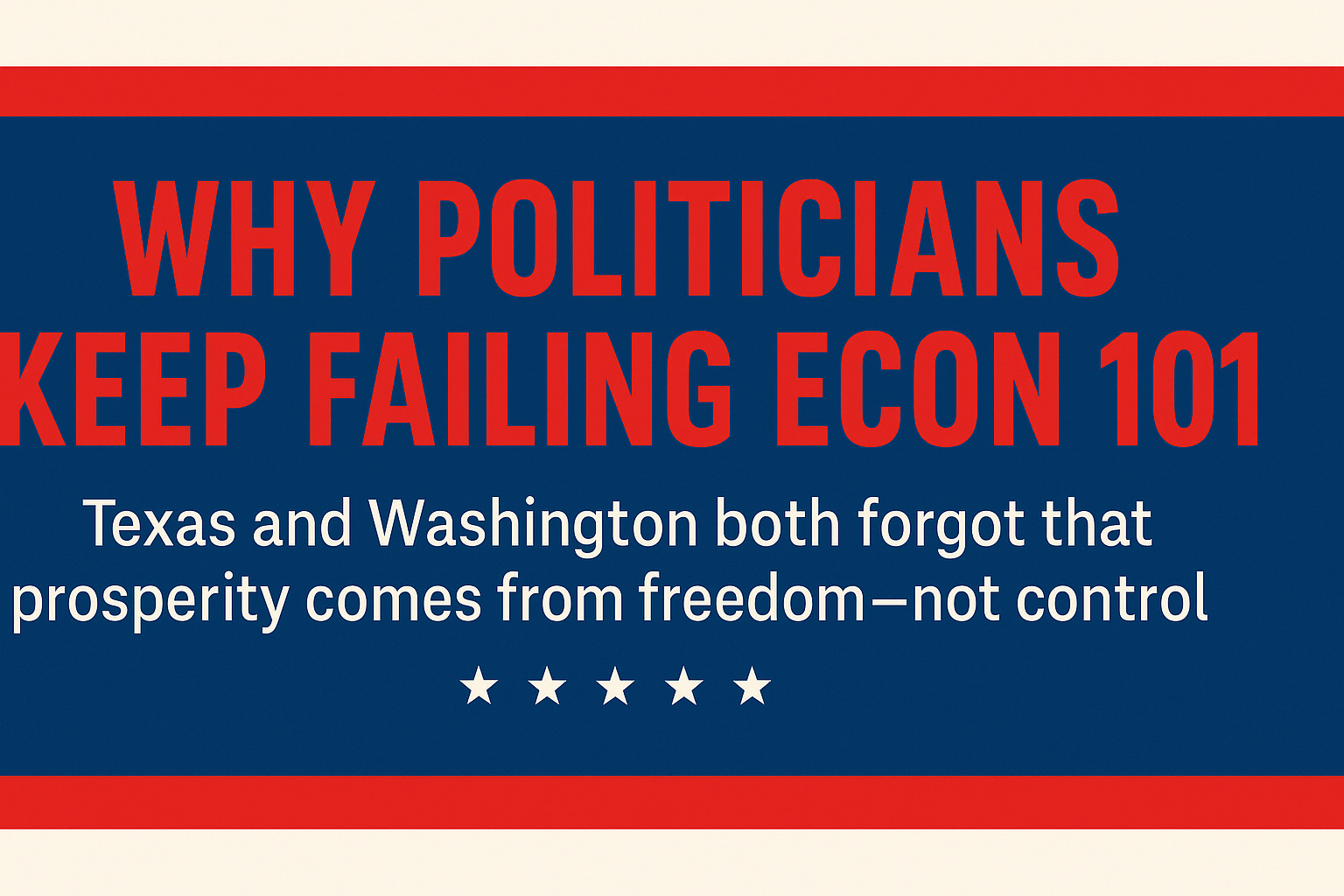
Why Politicians Keep Failing Econ 101
Texas and Washington both forgot that prosperity comes from freedom—not control.
Hello Friends!
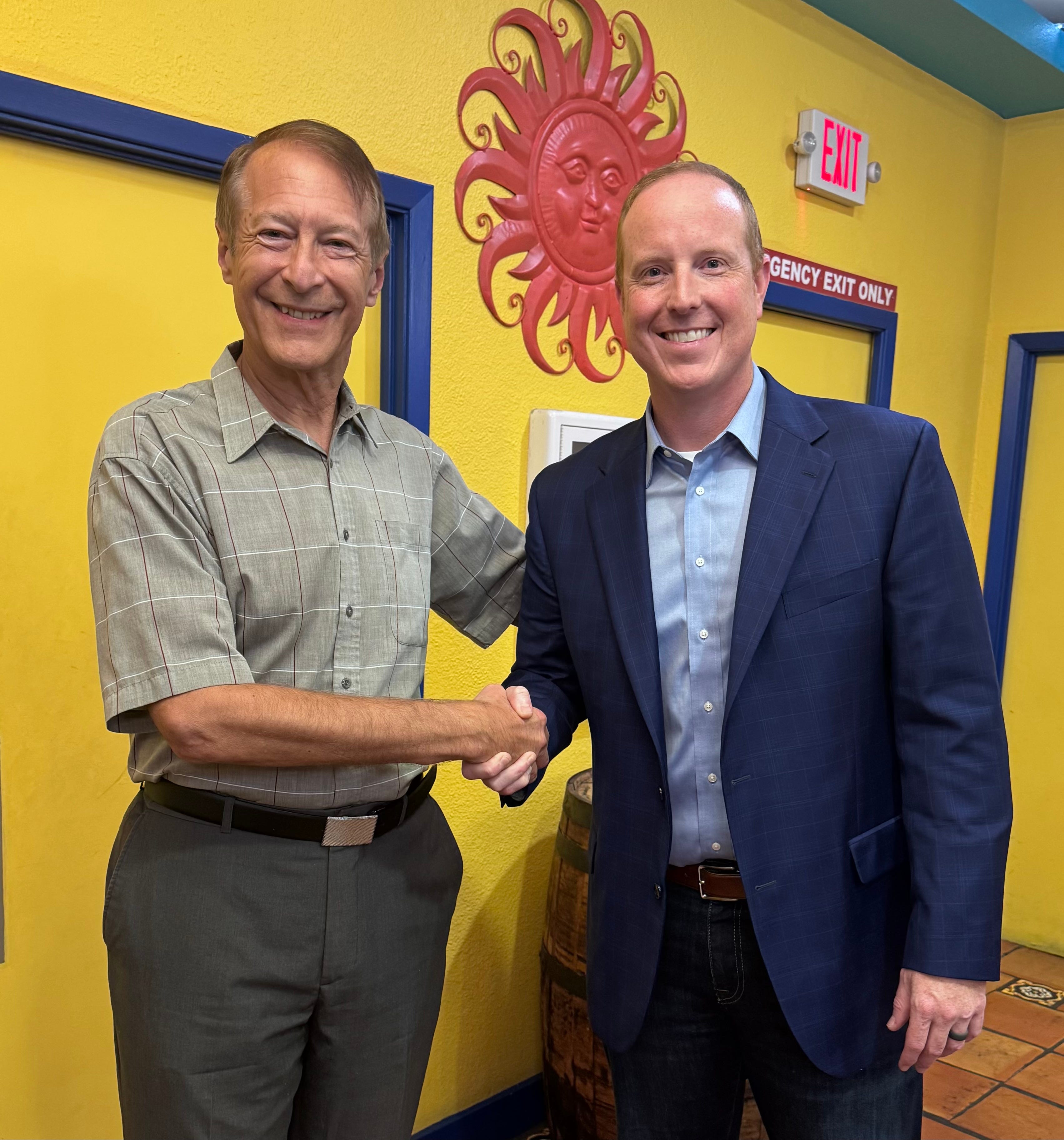
On Monday, I spoke to the Libertarian Party of Travis County in North Austin (pictured with Ted Brown). It was a room of people who didn’t need to be convinced that freedom works.
Still, it reminded me how few of our political leaders—at both the Texas Capitol and in Washington, D.C.—seem to remember even the most basic lessons of economics.
They talk about freedom, but govern like central planners. They praise capitalism, but subsidize corporations. They decry debt, then vote to raise spending. That’s how we’ve wound up with $37 trillion in national debt, a $6.6 trillion Federal Reserve balance sheet, and a Texas budget that’s grown twice as fast as population and inflation in recent years.
You’d think by now our leaders would understand: you can’t tax, print, or spend your way to prosperity. But too many keep trying.
Learning Economics the Hard Way
My understanding of economics didn’t come from Washington or a textbook. It came from South Houston, where I was raised by a single mom who dropped out of high school and struggled to keep food on the table. My dad, who battled epilepsy, was on disability, and lived with my grandma most of my childhood. We made too much money for welfare but never enough to feel secure. I learned early that nothing in life is free, especially not government programs claiming to be.
In my late teens and early twenties, I was chasing a music dream, drumming in a Houston rock band: Sindrome. But one sunny day on May 25, 2002, everything changed. A high-speed crash nearly ended my life. I was life-flighted to Hermann Hospital—and by God’s grace, walked out the same night. That moment reshaped my purpose.
I went back to school, became the first in my family to graduate college, and earned a Ph.D. in economics at Texas Tech University. I wanted to understand why some places flourish while others fail. What I found was simple: freedom, not government, drives prosperity.
That discovery carried me through nearly a decade at the Texas Public Policy Foundation, where I helped craft responsible budgeting reforms, and later to the White House Office of Management and Budget, where I served as Chief Economist under the first Trump administration. There, I saw firsthand how Washington’s bad incentives—spend now, worry later—were fueling inflation and stagnation.
Today, through President of Ginn Economic Consulting, work with more than 20 organizations, and host of The Let People Prosper Show, I’m still fighting to bring basic economics back to public policy—because what’s at stake isn’t abstract. It’s the future of families across this country and especially here in Texas.
The Basics Our Leaders Keep Ignoring
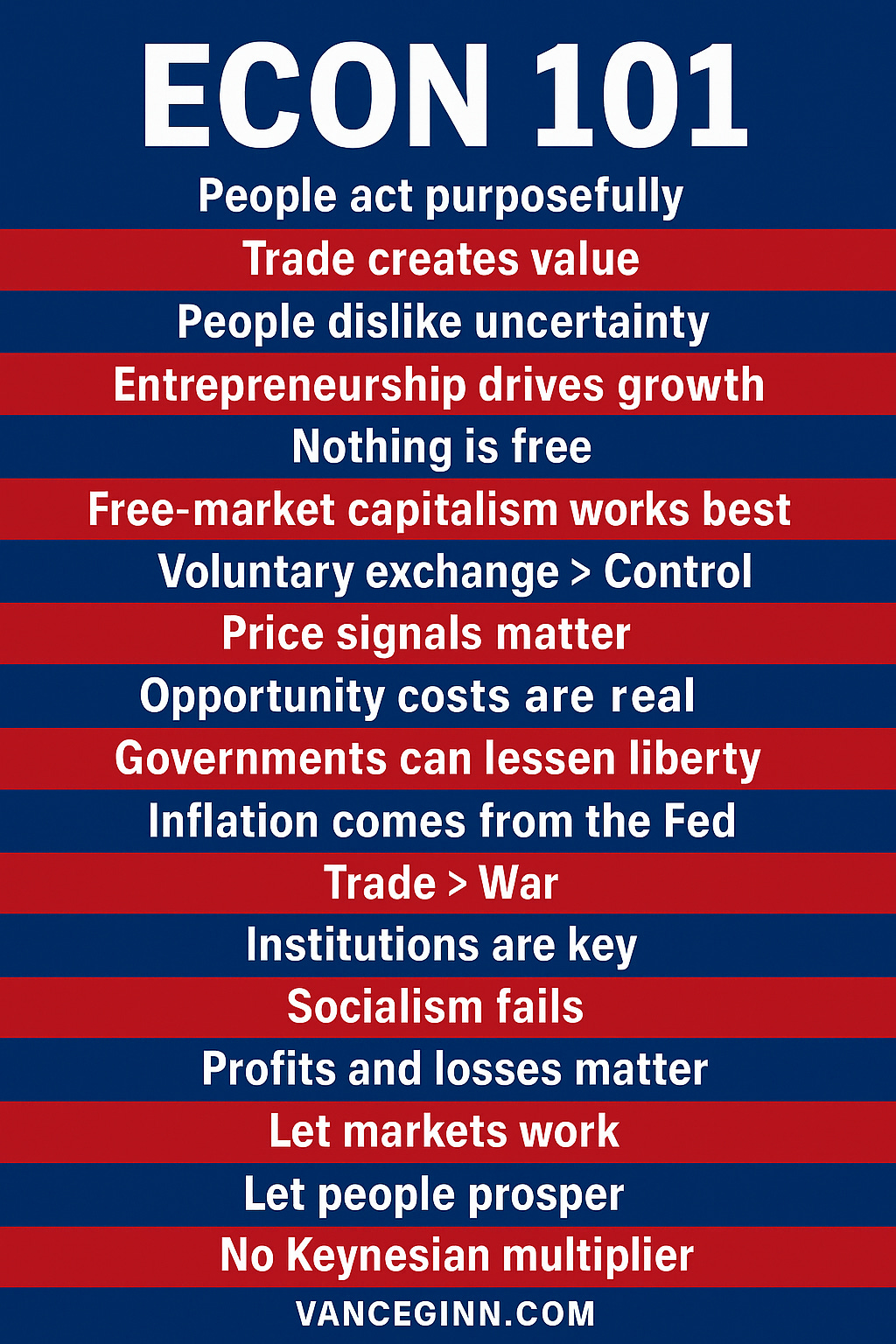
The laws of economics don’t bend for politics. Yet Texas and Washington act as if they can be rewritten by committee. Here are a few of my recent list of 20 foundations of Econ 101.
People act purposefully. No government agency can outthink millions of daily decisions by free individuals.
Trade creates value. Tariffs are taxes on Americans. The Trump administration’s 10 percent universal tariff on imports—roughly $380 billion a year—would raise costs on many things from tractors to groceries.
Nothing is free. Every government handout has a hidden bill—paid through higher taxes, debt, or inflation.
Entrepreneurs create prosperity. Government doesn’t “create jobs”—it just redistributes them. When Texas doles out billions in “economic development” subsidies or Washington hands out corporate tax credits, both pick winners and losers instead of trusting competition.
Spending discipline matters. When Texas spends faster than the people’s ability to pay for it, this squeezes taxpayers. When Washington does it, it weakens the economy. Either way, working families lose.
Sound money and limited government are essential. The Fed’s manipulation of interest rates has distorted markets, punished savers, and rewarded debt. That’s not a “policy tool”—it’s economic malpractice.
Texas once set the standard for fiscal restraint, but we’re drifting. State spending has grown far faster than people’s ability to pay for it in recent years. Local property taxes are forcing families out of their homes. And despite a record surplus, lawmakers refused to eliminate even a fraction of those taxes permanently. Meanwhile, Washington just keeps writing checks it can’t cash.
Both levels of government are failing the same class: Econ 101.
The Better Way
We can do better—and we know how. Limit government growth to less than population growth plus inflation. End property taxes so Texans can truly own their homes. Stop picking winners through corporate welfare and “megadeals” that cost more jobs than they create. Phase out the income tax so workers keep what they earn. And yes, rein in the Federal Reserve before it prints our prosperity into oblivion.
These aren’t partisan ideas. They’re common-sense principles grounded in human reality. When people are free to work, trade, save, and invest, prosperity follows. When politicians interfere, it fades.
I’ve seen it at every level—at the kitchen table in South Houston, at the Texas Capitol, and even inside the White House. Every economic success story starts with freedom. Every failure starts with control.
Closing Thoughts
The fight for economic sanity isn’t about numbers—it’s about people. It’s about the small business owner in Austin fighting red tape, the farmer in Lubbock hit by tariffs, the family in Fort Worth stretched thin by inflation and property taxes.
Freedom isn’t chaos. It’s order that arises from voluntary cooperation. It’s people solving problems faster and better than any bureaucrat ever could.
So, whether in Texas or Washington, it’s time to get back to the basics—spend less, trust markets, and let people prosper. Because every time we’ve tried freedom, it’s worked. Every time we’ve abandoned it, we’ve paid the price.
Let’s not make that mistake again.